It was a pleasure to burn
The phrase "It was a pleasure to burn" stands as the title of Part I of Fahrenheit 451 and the first words of the novel's narrative proper, establishing the psychological and ideological starting point from which the protagonist Guy Montag will eventually diverge. It is not merely a descriptive statement but a declaration of identity, a professional creed that Montag embodies with his entire sensorium before the story's transformative events take hold.
Origin and Immediate Context
The phrase appears as the heading of Part I and is immediately followed by a vivid, almost ecstatic description of Montag at work: "It was a special pleasure to see things eaten, to see things blackened and changed." The narrative presents the act of burning as a symphony conducted by Montag's hands, with the brass nozzle of the flamethrower as his instrument and the kerosene as venomous python spitting upon the world. The pleasure is physical and aesthetic—the blood pounds in his head, his eyes are "all orange flame with the thought of what came next," and he strides "in a swarm of fireflies." This is not a reluctant duty but a sensual gratification, complete with the old joke of wanting to shove a marshmallow on a stick into the furnace while "the flapping pigeon-winged books died on the porch and lawn of the house." The pleasure is so ingrained that Montag grins "the fierce grin of all men singed and driven back by flame," a smile that "never went away, it never ever went away, as long as he remembered."
The Pleasure as Professional Ethos
The pleasure of burning is not merely personal but institutional, embedded in the history and rules of the Firemen of America. The rulebook, which Montag and his colleagues consult, traces the profession's founding to 1790 and Benjamin Franklin, with the explicit purpose of burning "English-influenced books in the Colonies." The five rules that follow—answer the alarm swiftly, start the fire swiftly, burn everything, report back immediately, stand alert for other alarms—reduce the job to a mechanical sequence, but the pleasure transforms it into a ritual. Captain Beatty, the chief ideologue of the firemen, later explains to Montag that the profession evolved as a response to mass society: as population grew and media accelerated, books were levelled down, minorities demanded offense-free content, and the firemen became "custodians of our peace of mind, the focus of our understandable and rightful dread of being inferior." The pleasure of burning, in this framework, is the pleasure of maintaining social harmony by eliminating the sources of conflict and thought.
The Pleasure's Erosion and Transformation
Montag's encounter with Clarisse McClellan begins to unsettle the pleasure. Her question "Are you happy?" triggers a recognition that his happiness is a mask, and the pleasure of burning starts to feel hollow. After the burning of the old woman who chooses to die with her books, Montag vomits at the smell of kerosene, a physical rejection of what once delighted him. The pleasure is further complicated when he reads poetry to his wife's friends, Mrs. Phelps and Mrs. Bowles, and witnesses Mrs. Phelps cry uncontrollably—a reaction that proves the power of what he burns. By the time Montag kills Captain Beatty with the flamethrower, the pleasure has inverted: he uses fire not to destroy books but to destroy the enforcer of book-burning. Later, floating in the river after his escape, Montag reflects that the sun burns every day, burning time itself, and that "one of them had to stop burning." The pleasure of burning, once the core of his identity, is replaced by the imperative to preserve.
The Pleasure as Thematic Counterpoint
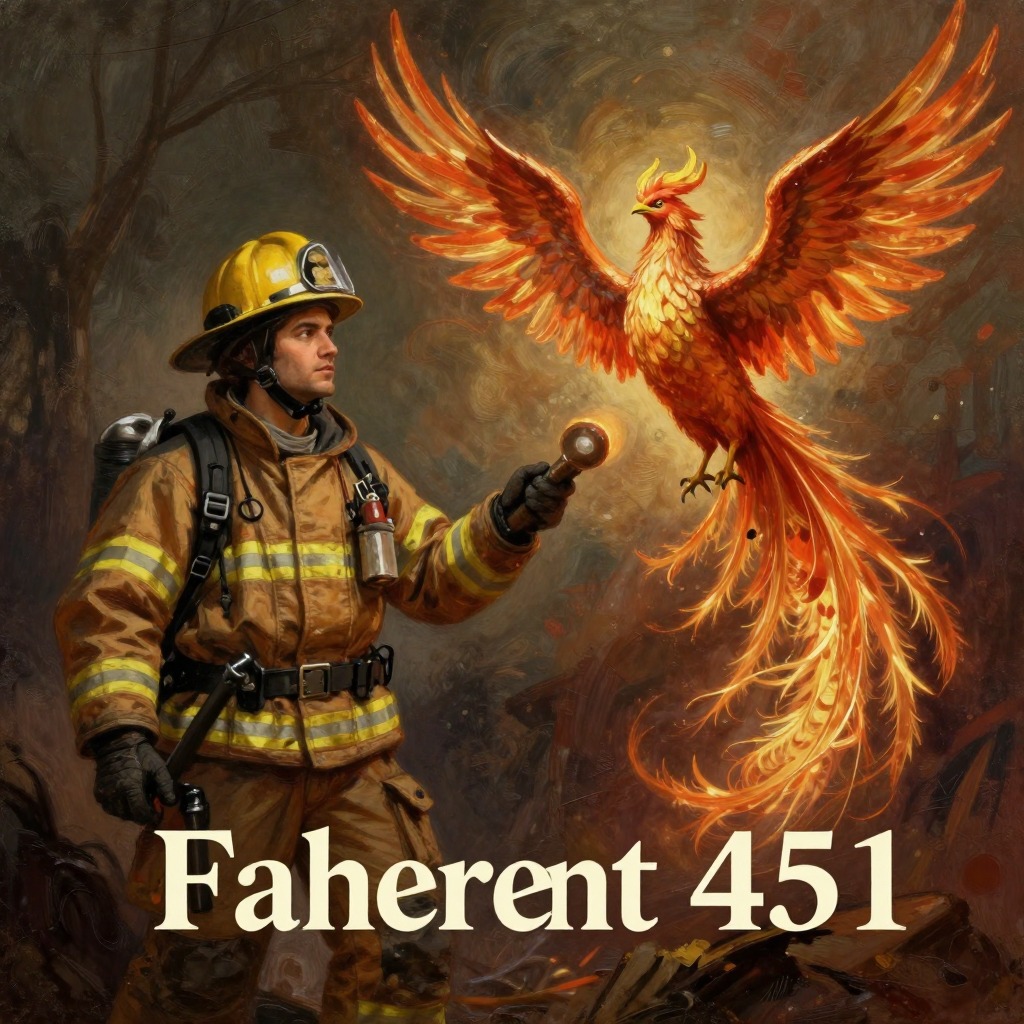
The phrase "It was a pleasure to burn" functions as the novel's thematic antithesis to the later vision of fire as warmth and community. When Montag encounters Granger and the book people by their campfire, he realizes that "he hadn't known fire could look this way. He had never thought in his life that it could give as well as take." The pleasure of burning, which Montag once experienced as a solitary, destructive ecstasy, is replaced by the shared, generative warmth of a fire around which men talk and remember. Granger's story of the Phoenix—a bird that burns itself up and is reborn—parallels Montag's own trajectory: he must burn away his old self to be reborn as a keeper of knowledge. The novel's final image, of Montag walking north with the book people toward the ruined city, carrying the Book of Ecclesiastes in his memory, completes the inversion. The pleasure of burning becomes the pleasure of remembering, of holding the words that fire could not destroy.
The Phrase's Narrative and Structural Role
As the title of Part I, "It was a pleasure to burn" marks the novel's first movement, the world as Montag initially knows it. Part II, "The Sieve and the Sand," and Part III, "Burning Bright," trace the dissolution of that pleasure and its replacement by a different kind of fire. The phrase thus serves as a structural anchor, a point of departure that the entire narrative works to undo. It also encapsulates the novel's critique of a society that has substituted sensation for meaning, where the destruction of thought can be experienced as a pleasure because thought itself has been rendered obsolete. Montag's journey is measured by his distance from this opening declaration: the man who once found pleasure in burning books ends by becoming a book himself.